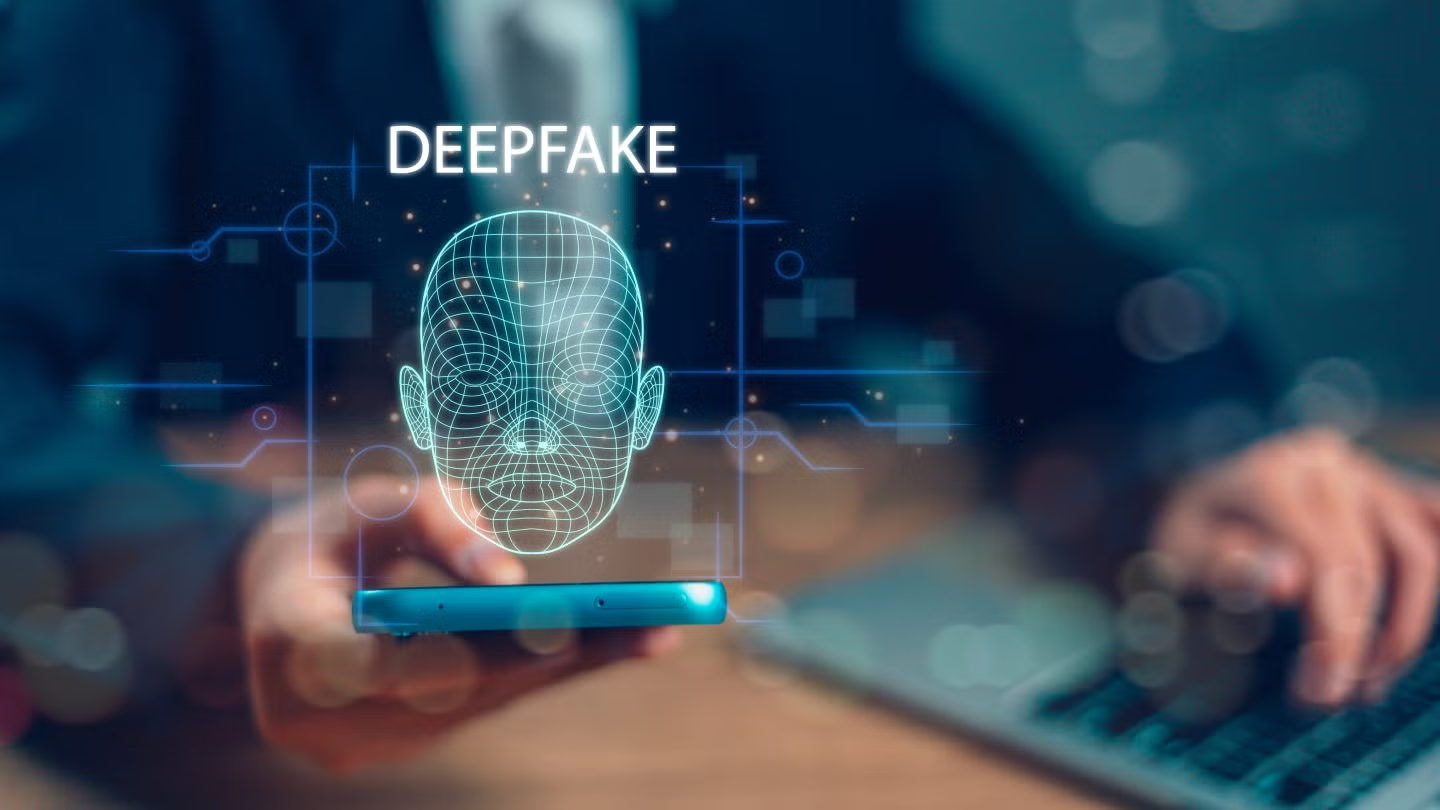
We stand at a precipice of a new era, one where seeing is no longer believing. The rapid advancement of artificial intelligence has birthed a powerful and deeply concerning tool: the deepfake. This technology, a portmanteau of “deep learning” and “fake,” refers to hyper-realistic synthetic media where a person in an existing image or video is replaced with someone else’s likeness. More than just a vehicle for entertainment or meme creation, deepfake technology presents a clear and present danger to the very foundations of democratic society. It threatens to erode public trust, manipulate electoral processes, and create a reality where truth is subjective and chaos is manufacturable. This article delves into the multifaceted threat deepfakes pose to democracy, exploring their evolution, their immediate dangers, and the critical strategies we must employ to defend our shared reality.
Understanding the Beast: What Are Deepfakes and How Do They Work?
To comprehend the threat, one must first understand the mechanism. Deepfakes are created using a branch of AI called generative adversarial networks (GANs). Imagine two AI systems locked in a constant duel:
A. The Generator: This AI’s role is to create a fake image or video. It starts with random noise and gradually shapes it into a forgery, attempting to mimic the target person’s appearance, voice, and mannerisms.
B. The Discriminator: This AI acts as the critic. Its job is to analyze the generator’s creation and determine whether it is real or fake.
These two systems work in a relentless loop. The generator produces a fake, the discriminator tries to catch it. Each time the discriminator succeeds, the generator learns from its mistakes and creates a more convincing fake. This cycle continues thousands, even millions, of times, until the generator becomes so adept that the discriminator can no longer tell the difference. The result is a deepfake so seamless and believable that it can deceive human eyes and ears. This technology has evolved from a niche academic pursuit to an accessible tool, with open-source software and user-friendly apps lowering the barrier to entry for malicious actors.
The Assault on Truth: How Deepfakes Erode Democratic Foundations
Democracy is not merely a system of government; it is an ecosystem that thrives on a informed citizenry, public trust, and accountable leadership. Deepfakes attack each of these pillars with terrifying precision.
A. The Erosion of Public Trust and Shared Reality
A functional society requires a common set of facts upon which to base debates and decisions. Deepfakes shatter this consensus. When a video can show a world leader declaring war or a candidate admitting to a crime they never committed, it becomes impossible to agree on what is real. This creates a “liar’s dividend,” where even genuine evidence can be dismissed as a potential deepfake. A politician caught in a scandal can simply cry “deepfake!” to sow doubt and evade accountability. This erosion of trust extends beyond politicians to the institutions we rely on: the media, the judiciary, and law enforcement. If everything can be faked, trust evaporates, and society fractures into pockets of people believing incompatible realities.
B. Electoral Manipulation and Political Sabotage
Elections are the heartbeat of democracy, and deepfakes are a potent weapon for interference, both foreign and domestic. The threats are multifaceted:
-
October Surprises: Imagine a hyper-realistic video of a leading candidate, released days before an election, showing them accepting a bribe or using racial slurs. Even if debunked 24 hours later, the damage to their reputation could be irreversible and alter the election’s outcome.
-
Voter Suppression: Malicious actors could target specific demographic groups with tailored disinformation. A deepfake audio clip could be sent to a community, falsely announcing that their polling place has changed or that the election has been postponed.
-
Undermining Legitimacy: After an election, the losing side could use fabricated evidence of voter fraud—deepfaked videos of ballot stuffing or hacking to challenge the results and delegitimize the victorious government, leading to political instability and violence.
C. Social Unrest and Targeted Harassment
Deepfakes can be weaponized to incite violence and target individuals. A deepfake video could be engineered to show ethnic or religious leaders insulting another group or calling for violence, potentially sparking real-world riots. Furthermore, this technology has been horrifically used to create non-consensual pornography, overwhelmingly targeting women and journalists to silence, humiliate, and intimidate them. This form of harassment drives people out of public life and degrades civic discourse.
Case Studies: Deepfakes in the Wild – From Theory to Reality
While the widespread catastrophic deepfake attack hasn’t yet materialized, several incidents offer a chilling preview of what’s to come.
-
The Belgian Political Fake (2018): A video was circulated of Belgian Prime Minister Charles Michel giving a speech that linked climate change to terrorist attacks and advocated for aggressive policies. The video was a crude edit, not a sophisticated deepfake, but it still sparked outrage and demonstrated the public’s susceptibility to manipulated media.
-
The Gabon Coup Attempt (2019): After President Ali Bongo Ondimba suffered a stroke, a New Year’s address showed him looking frail and unlike himself. Rumors spread that the video was a deepfake, fueling a military coup attempt. The video was likely real, but the mere suspicion of a deepfake was enough to destabilize a nation.
-
The Ukrainian President “Surrender” Deepfake (2022): During the Russian invasion of Ukraine, a deepfake video surfaced appearing to show President Volodymyr Zelenskyy telling his soldiers to lay down their arms and surrender. It was quickly identified as fake and taken down, but it highlighted the potential for deepfakes to be used as a weapon of war and psychological manipulation.
Building the Digital Immune System: Multifaceted Strategies to Combat Deepfakes
There is no single silver bullet to defeat the deepfake threat. A robust defense requires a coordinated effort across technology, law, education, and journalism.
A. Technological Solutions and Digital Provenance
The same AI used to create deepfakes can be harnessed to detect them. Tech companies and researchers are developing detection tools that look for subtle tells unnatural blinking patterns, inconsistent lighting, audio-visual mismatches, and digital artifacts invisible to the human eye. Furthermore, a promising approach is “digital provenance.” This involves cryptographically signing authentic media at the source (e.g., on a journalist’s camera) so its origin and integrity can be verified as it travels across the internet. Initiatives like the Coalition for Content Provenance and Authenticity (C2PA) are working to make this a standard.
B. Legislative and Regulatory Frameworks
The law must adapt to the digital age. While careful not to stifle innovation or free speech, governments need to create clear legal consequences for malicious deepfake creation and distribution. This includes:
-
Criminalizing Malicious Deepfakes: Laws specifically targeting deepfakes used for election interference, non-consensual pornography, fraud, and incitement to violence.
-
Mandatory Labeling: Requiring platforms and creators to clearly label all synthetic media, providing users with immediate context.
-
Platform Accountability: Holding social media companies responsible for the rapid removal of harmful, malicious deepfakes, akin to copyright takedown laws.
C. Media Literacy and Public Education
Technology and laws are insufficient without an educated populace. We must launch a global initiative to enhance digital media literacy, teaching people to be critical consumers of online content. This includes:
-
Teaching Verification Skills: Educating citizens on how to reverse-image search, check sources, and look for reporting from established news outlets before sharing content.
-
Promoting Healthy Skepticism: Encouraging people to pause and question emotionally charged content, especially if it confirms their pre-existing biases.
-
Integrating into Curriculum: Making digital literacy a core component of education from a young age.
D. The Role of Journalism and Fact-Checking
The Fourth Estate has a critical role to play. News organizations must invest in forensic verification tools and train journalists to detect synthetic media. They must also prioritize clear, rapid debunking of deepfakes when they emerge, communicating the truth in a way that is as compelling and shareable as the lie itself. Collaboration between international fact-checking organizations is key to stopping the cross-border spread of disinformation.
The Ethical Quandary: Not All Deepfakes Are Malicious
It is crucial to acknowledge that deepfake technology itself is neutral; its impact depends on its application. There are legitimate and positive use cases:
-
Film and Entertainment: De-aging actors for flashback sequences, resurrecting historical figures for documentaries, or allowing performers to work in multiple languages.
-
Education: Creating interactive historical lessons where students can “converse” with synthetic versions of historical leaders.
-
Accessibility: Dubbing videos into different languages with perfect lip-sync, making content accessible to a global audience.
-
Art and Satire: Providing new tools for artists and commentators to create provocative and innovative works.
The challenge for society is to foster this innovation while creating strong guardrails to prevent abuse.
Conclusion: Defending Reality in the Digital Age
The deepfake threat is not a distant sci-fi fantasy; it is a pressing political and social crisis. The technology will only become more convincing, more accessible, and more dangerous. The battle to protect democracy from synthetic manipulation is a race against time. Winning requires a whole-of-society approach a fusion of sophisticated technology, smart regulation, relentless journalism, and, most importantly, a public equipped with the knowledge and critical thinking skills to navigate this new landscape. Our shared reality, and the democratic systems built upon it, depend on our vigilance and our commitment to truth. The time to build our defenses is now, before the line between fact and fiction vanishes for good.