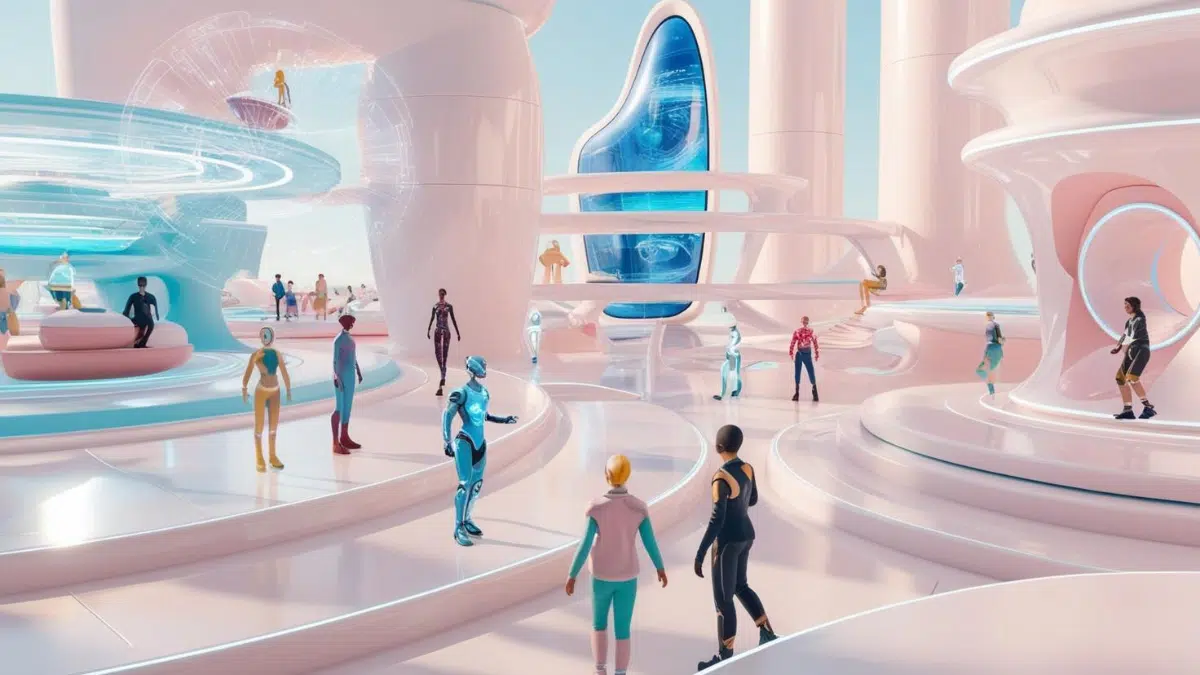
The digital landscape is on the cusp of its most profound transformation since the advent of the internet itself. We are transitioning from a world of flat, two-dimensional web pages to a new, immersive dimension of experience: the metaverse. This isn’t merely a shift in technology; it’s a fundamental reimagining of how we connect, work, create, and exist online. Metaverse development is not a distant sci-fi fantasy it’s happening now, and its relentless progress is poised to change everything we know about the digital realm. This comprehensive guide will delve deep into the core of this revolution, exploring its foundational technologies, its sweeping impact across industries, and the critical challenges it must overcome to realize its full, world-altering potential.
Understanding the Metaverse: Beyond the Hype
At its core, the metaverse is a hypothesized iteration of the internet, consisting of persistent, shared, 3D virtual spaces linked into a perceived virtual universe. It is the convergence of physical and digital reality, often accessed via VR headsets, AR glasses, and even traditional screens. Think of it not as a single app or platform, but as a vast, interconnected network of experiences a digital “place” you can step into, rather than just look at.
Key characteristics that define the metaverse include:
-
Persistence: The world continues to exist and evolve even when you are not logged in.
-
Synchrony and Live Experience: It happens in real-time, for everyone, just like life itself.
-
A Fully Functioning Economy: Individuals and businesses will be able to create, own, invest, sell, and be rewarded for a wide range of work and intellectual property.
-
Interoperability: The ability to seamlessly take your digital assets (avatars, clothing, vehicles) from one platform or world to another is a crucial, though challenging, goal.
-
Massive Scale: It will support countless users simultaneously, each with their own individual presence.
The Foundational Pillars of Metaverse Development
Building such a complex and immersive ecosystem requires several cutting-edge technologies to mature and integrate seamlessly. These are the building blocks making the metaverse possible.
A. Blockchain Technology and Digital Assets
Blockchain provides the decentralized framework for trust and ownership in the metaverse. It enables:
-
Non-Fungible Tokens (NFTs): These act as deeds of ownership for unique digital items—land, avatar skins, artwork, and collectibles. They prove authenticity and scarcity.
-
Cryptocurrencies: Digital currencies and tokens facilitate commerce within these virtual worlds, allowing users to buy, sell, and trade goods and services.
-
Smart Contracts: These self-executing contracts automate transactions and agreements, enabling complex economies and governance systems without a central authority.
B. Virtual Reality (VR) and Augmented Reality (AR)
These are the primary gateways to immersive metaverse experiences.
-
VR fully immerses users in a digital environment, typically through a headset, making them feel physically present in a non-physical world. This is crucial for social gatherings, virtual tourism, and advanced simulations.
-
AR overlays digital information onto the physical world, viewed through glasses or a smartphone camera. This technology will blend our real and digital lives, enhancing everything from navigation and shopping to industrial maintenance and education.
C. Artificial Intelligence (AI) and Machine Learning
AI is the invisible engine that will power the metaverse, making it dynamic and intelligent.
-
Smart NPCs: AI will create highly realistic and responsive Non-Player Characters (NPCs) that can interact with users in nuanced ways, serving as guides, assistants, or opponents.
-
Avatar Creation: AI algorithms can analyze 2D images or 3D scans to generate highly realistic and expressive digital avatars that mirror our real-life movements and emotions.
-
World Building: AI can be used to automatically generate vast, intricate virtual landscapes, objects, and even soundscapes, drastically reducing development time and creating more complex environments.
D. Advanced Networking Infrastructure (5G and Beyond)
The latency and bandwidth demands of the metaverse are enormous. Transmitting vast amounts of 3D data in real-time requires a robust network. 5G technology, with its high speed, low latency, and ability to connect a massive number of devices simultaneously, is essential for a smooth, lag-free metaverse experience. Future 6G networks will push this even further, making truly pervasive and immersive experiences possible.
E. The Spatial Computing Layer
This refers to the processes and tools that allow our devices to understand and interact with the physical space around us in 3D. It merges VR, AR, AI, and IoT to digitize objects and spaces, enabling the digital and physical worlds to interact meaningfully.

Industries Being Transformed by the Metaverse
The impact of the metaverse extends far beyond gaming and entertainment. It is set to revolutionize nearly every sector of the global economy.
A. The Future of Work and Remote Collaboration
The “office” will be redefined. Instead of flat video calls on Zoom, teams will gather in a virtual boardroom, brainstorming around a 3D model or whiteboarding ideas in mid-air. This restores a sense of spatial presence and camaraderie lost in traditional remote work. Companies like Microsoft (with Mesh for Teams) and Meta are heavily investing in this enterprise metaverse, believing it will be the next evolution of hybrid work.
B. A New Paradigm for Education and Training (EdTech)
Imagine a history class where students can virtually walk through ancient Rome, or a medical class where trainees can perform complex surgery on a holographic patient without risk. The metaverse enables experiential learning, allowing students to interact with knowledge rather than just read about it. This hands-on approach dramatically improves retention and understanding.
C. The Revolution of Retail and E-Commerce
Shopping will become an experience. You won’t just look at pictures of a sofa online; you’ll see a life-size 3D model of it in your actual living room via AR. You can try on digital clothing that fits your avatar’s exact measurements, which can then be manufactured and shipped to you. Virtual stores will offer unique, branded experiences that are impossible in the physical world.
D. Social Connectivity and Community Building
Social media will evolve from profiles and feeds to shared spaces and experiences. Instead of “liking” a friend’s post, you could give them a virtual high-five, attend a concert together with your avatars, or simply hang out in a digital recreation of a favorite park, regardless of your physical locations. This deepens social connections in the digital space.
E. Innovative Frontiers in Healthcare
The applications in healthcare are vast and life-changing. Therapists are already using VR to treat PTSD through controlled exposure therapy. Surgeons use AR overlays to visualize anatomy during procedures. Medical students can practice in hyper-realistic simulations. The metaverse will enable more personalized, accessible, and effective care.
F. The Future of Real Estate and Urban Planning
Architects and developers can create full-scale digital twins of buildings and cities before breaking ground. Potential buyers can take VR tours of properties from anywhere in the world. City planners can simulate traffic patterns, emergency scenarios, and the environmental impact of new projects, leading to smarter, more sustainable urban development.
Significant Challenges on the Road to Adoption
For all its promise, the metaverse’s path is fraught with significant hurdles that developers, companies, and regulators must address.
A. Privacy and Data Security Concerns
The metaverse will collect unprecedented amounts of deeply personal data: biometric data from eye-tracking and motion sensors, conversation recordings, and even emotional responses. Protecting this data from breaches and misuse is a monumental challenge that requires new security paradigms and robust regulations.
B. The Imperative of Digital Equity and Access
There is a very real risk of a “metaverse divide.” High-quality VR/AR hardware, powerful computing devices, and reliable high-speed internet are expensive. Ensuring that this new digital frontier is accessible and affordable to all, not just the wealthy, is critical to prevent creating a new layer of social and economic inequality.
C. Establishing Interoperability and Open Standards
For the metaverse to truly function as a unified space, different platforms and worlds need to be able to interact. Your avatar and digital possessions should be portable. Currently, tech giants are building walled gardens. Achieving true interoperability requires collaboration on open standards, which conflicts with corporate competition and the desire to control a platform.
D. User Safety and Content Moderation
If the internet has taught us anything, it’s that online spaces can be breeding grounds for harassment, hate speech, and toxic behavior. In an immersive 3D environment, these negative experiences can feel far more visceral and damaging. Creating effective tools for moderation, user reporting, and safety within these complex environments is an unsolved problem.

The Future Horizon: What Comes Next?
The full vision of a seamless, interconnected metaverse is still years, if not decades, away. However, its development is accelerating. We will likely see:
-
Hybrid Experiences: A continued blend of physical and digital events, like concerts where a live audience is joined by thousands of virtual attendees.
-
The Rise of the Creator Economy: New tools will empower a wave of creators to build experiences, assets, and worlds within the metaverse, fueling a new digital economy.
-
Integration with AI Agents: Our digital lives will be assisted by sophisticated AI agents that can manage tasks, provide information, and represent us in the metaverse.
-
Physical-Digital Fusion: With advancements in haptics and neural interfaces, the line between what is physical and what is digital will continue to blur, leading to even more immersive experiences.
Conclusion: A Change That is Already Underway
Metaverse development is far more than a technological trend; it is a paradigm shift. It represents the next evolution of the internet a shift from a web of information to a web of experiences. While challenges around privacy, access, and interoperability are significant, the potential to reshape how we work, learn, play, and connect is undeniable. The revolution is not coming; it is already here, being built piece by piece in labs and studios around the world. To ignore it is to ignore the future of human interaction itself. The question is no longer if the metaverse will change everything, but how we will choose to build it and ensure it is a change for the better.