
In an era defined by breakneck technological evolution and shifting global economies, businesses face a simple, yet profound, ultimatum: adapt or become obsolete. The catalyst for this adaptation is no longer a luxury or a forward-thinking strategy for the distant future; it is an immediate, non-negotiable imperative. This catalyst is digital transformation. More than just a buzzword, it represents a fundamental rewiring of how an organization delivers value to its customers, empowers its employees, and operates within its market. Investing in digital transformation now is not merely about keeping pace with competitors; it’s about future-proofing your business, unlocking unprecedented efficiency, and securing a dominant position in the new digital economy. This comprehensive guide will delve into the critical reasons why this investment cannot wait, the core pillars of a successful strategy, and how to navigate the journey effectively.
Understanding Digital Transformation: Beyond Technology
Before diving into the “why,” it’s essential to define the “what.” Digital transformation is often mistakenly reduced to adopting new software or moving data to the cloud. While technology is a crucial enabler, true transformation is holistic. It is the integration of digital technology into all areas of a business, resulting in fundamental changes to how the business operates and how it delivers value to customers. It’s a cultural shift that requires organizations to continually challenge the status quo, experiment often, and get comfortable with failure. This means walking away from long-standing business processes that were built for a different time and embracing new practices that are still being defined.
The Burning Platform: Why You Must Invest Immediately
The question is no longer if a business should transform, but how quickly it can be done. Procrastination is a strategic risk with tangible consequences. Here are the compelling reasons demanding immediate action:
A. Exponential Acceleration of Consumer Expectations: The modern consumer is digitally native. They demand hyper-personalization, seamless omnichannel experiences, instant customer service (via chatbots or AI), and effortless transactions. Companies that cannot meet these expectations will swiftly lose market share to agile competitors who can.
B. Unprecedented Competitive Pressure: The competitive landscape is no longer linear. Disruptors from outside your traditional industry can emerge overnight, leveraging digital tools to offer better, faster, and cheaper solutions. Investing now allows you to be the disruptor, not the disrupted.
C. The Criticality of Data-Driven Decision Making: In the digital age, intuition is no longer enough. Businesses sitting on vast amounts of untapped data are missing out on a goldmine of insights. Digital transformation unlocks the power of data analytics and business intelligence, enabling decisions based on real-time information, predictive trends, and deep customer understanding, leading to optimized operations and new revenue streams.
D. Operational Resilience and Agility: The recent global events have proven that resilience is paramount. Digitally transformed organizations, with cloud-based infrastructures and remote work capabilities, were able to pivot and adapt almost overnight. This agility is now a core component of business continuity planning.
E. Massive Gains in Efficiency and Cost Reduction: Automating repetitive, manual tasks through Robotic Process Automation (RPA) and AI frees up human capital for higher-value, strategic work. It also drastically reduces operational errors and costs associated with legacy, paper-based systems.
The Core Pillars of a Successful Digital Transformation Strategy
A successful transformation is not a single project but a continuous journey built on several foundational pillars.
A. Cultural and Organizational Shift: This is arguably the most challenging yet critical pillar. Transformation requires buy-in from every level, from the C-suite to the front lines. It involves fostering a culture of innovation, collaboration, and continuous learning where employees are empowered to suggest and adopt new ways of working.
B. Customer-Centricity: Every technological adoption should be viewed through the lens of customer value. The goal is to use digital tools to solve customer pain points, enhance their journey, and create more meaningful and engaging interactions. This often involves mapping the customer experience to identify key areas for digital intervention.
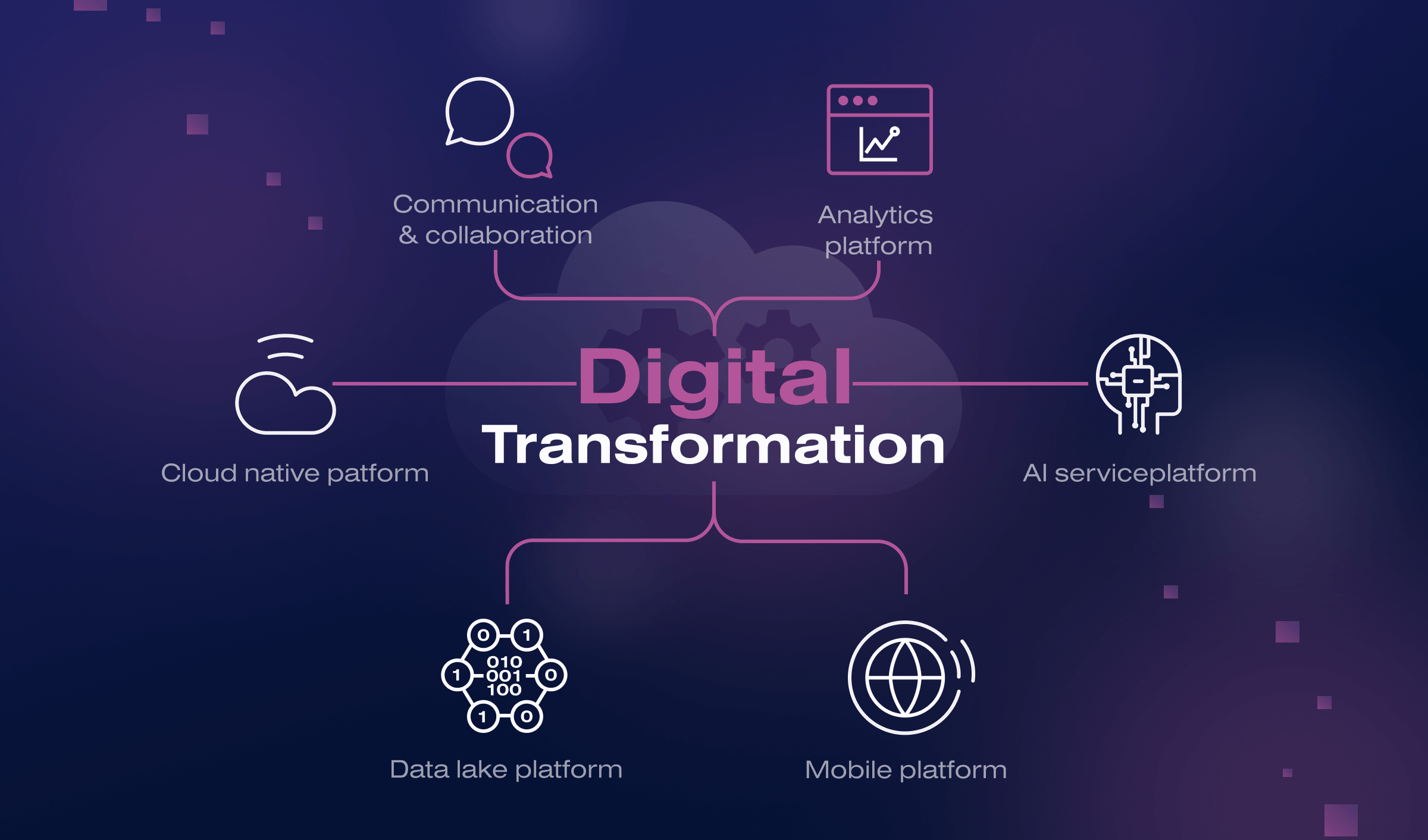
C. Technology Integration: This involves selecting and implementing the right stack of technologies. Key areas include:
-
Cloud Computing: Provides scalability, flexibility, and cost-efficiency.
-
Data Analytics and AI/ML: For deriving insights, personalizing experiences, and automating complex processes.
-
Cybersecurity: A non-negotiable element. As you digitize, your attack surface expands. A robust security framework must be woven into the fabric of your transformation from day one.
-
Internet of Things (IoT): For businesses in manufacturing, logistics, or retail, IoT sensors provide real-time data on supply chains, equipment health, and customer behavior.
D. Operational Process Evolution: This involves re-engineering existing processes to be leaner and more efficient. It means breaking down data silos between departments to create a single source of truth and streamlining workflows to accelerate time-to-market for products and services.
E. Leadership and Vision: Transformation must be driven from the top. Leaders must articulate a clear, compelling vision for the digital future, allocate the necessary resources, and champion the change relentlessly throughout the organization.
Navigating the Journey: A Phased Approach to Implementation
A. Assessment and Vision Setting: Begin with a thorough audit of your current technological stack, processes, and skills gaps. Define what success looks like with clear, measurable goals (e.g., increase online sales by 30%, reduce customer service response time by 50%).
B. Building a Coalition and Roadmap: Secure executive sponsorship and assemble a cross-functional team to lead the charge. Develop a phased roadmap with short-term wins (quick wins that build momentum) and long-term strategic goals. Prioritize initiatives based on impact and feasibility.
C. Pilot Programs and Iteration: Instead of a risky “big bang” approach, launch small-scale pilot programs for specific processes or in single departments. Use agile methodologies to test, learn, gather feedback, and iterate on the solution before a full-scale roll-out. This minimizes risk and demonstrates tangible value early.
D. Scale and Integrate: Once a pilot is proven successful, develop a plan to scale it across the organization. Ensure new digital tools are properly integrated with existing systems to avoid creating new silos.
E. Continuous Evolution and Measurement: Digital transformation is not a one-off event. Continuously monitor KPIs, gather feedback, and stay abreast of emerging technologies. Be prepared to continuously adapt and evolve your strategy.

Overcoming Common Challenges and Roadblocks
A. Resistance to Change: Human inertia is a powerful force. Overcome this through transparent communication, comprehensive training, and involving employees in the process early on.
B. Budget Constraints and Proving ROI: Secure funding by building a strong business case that focuses on ROI not just in monetary terms, but also in improved customer satisfaction, employee engagement, and risk mitigation. Start with low-cost, high-impact projects to prove value.
C. Legacy Systems Integration: Older systems can be difficult and expensive to replace. Often, a hybrid approach using APIs and middleware to connect legacy systems with new cloud applications is the most practical first step.
D. Cybersecurity Threats: Partner with cybersecurity experts to conduct thorough risk assessments throughout the transformation process. Implement a “zero-trust” security model and ensure all employees are trained on security best practices.
E. Talent and Skill Gaps: Invest in upskilling and reskilling your current workforce. Simultaneously, consider strategic hiring for key digital roles and explore partnerships with external experts and consultants to fill immediate gaps.
Conclusion: The Time for Strategic Investment is Now
The digital tide is rising. Organizations that choose to invest in digital transformation now are effectively building a vessel to not only survive but to sail ahead of the competition. They are investing in resilience, relevance, and long-term growth. The initial investment whether financial, temporal, or cultural pales in comparison to the existential cost of inaction. The future belongs to those who are agile, data-informed, and customer-obsessed. By embracing a strategic, phased, and people-centric approach to digital transformation, you can redefine your industry and secure your company’s legacy for decades to come. The journey begins with a single, decisive step: the commitment to start today.